

A line of towering, rust-red dunes rising sharply from luminous white salt pans – this is Sossusvlei, an area small in size but large in reputation (and dune size!). It’s the most iconic and visited part of the ancient Namib Desert, which basically covers all of Namibia’s coastline. The Namib-Naukluft National Park covers the central part of this desert, which is where Sossusvlei is located. You will find yourself in a place of superlatives, with the Namib being the world’s oldest desert (no less than 55 million years old) and one of the driest parts of the continent and Sossusvlei harbouring some of the highest dunes in Africa – get ready to be impressed!


A poetic dead-end
The name Sossusvlei draws from two languages: sossus (Nama for ‘dead-end’) and vlei (Afrikaans for ‘marsh’). Put together, it translates to the rather poetic dead-end marsh. And it literally is, because the Tsauchab River (coming from the Naukluft mountain range) was blocked here by the towering dunes and simply ran out of water – 60 kilometres from reaching the Atlantic Ocean!
Most of the year, the former riverbeds are bone-dry, shimmering white salt pans that famously and beautifully contrast with Sossusvlei’s massive red dunes. Every so often, however, generous rains grant the river a triumphant return. The pans fill, transforming into a shimmering lake that perfectly mirrors the surrounding dunes, creating a sight that is just as impressive as when everything is dry. It never lasts, of course, but that’s part of the magic of Sossusvlei.
Dunes, pans and death
The dunes in Sossusvlei are famous because of their size – they can reach heights of over 300 metres, often sculpted by the wind into elegant star or stripe shapes. The biggest dunes even have their own name, with Dune 45 being the most photographed on the African continent (as you can conquer its 80 metres on foot), and Big Daddy being one of the largest, with 325 metres.
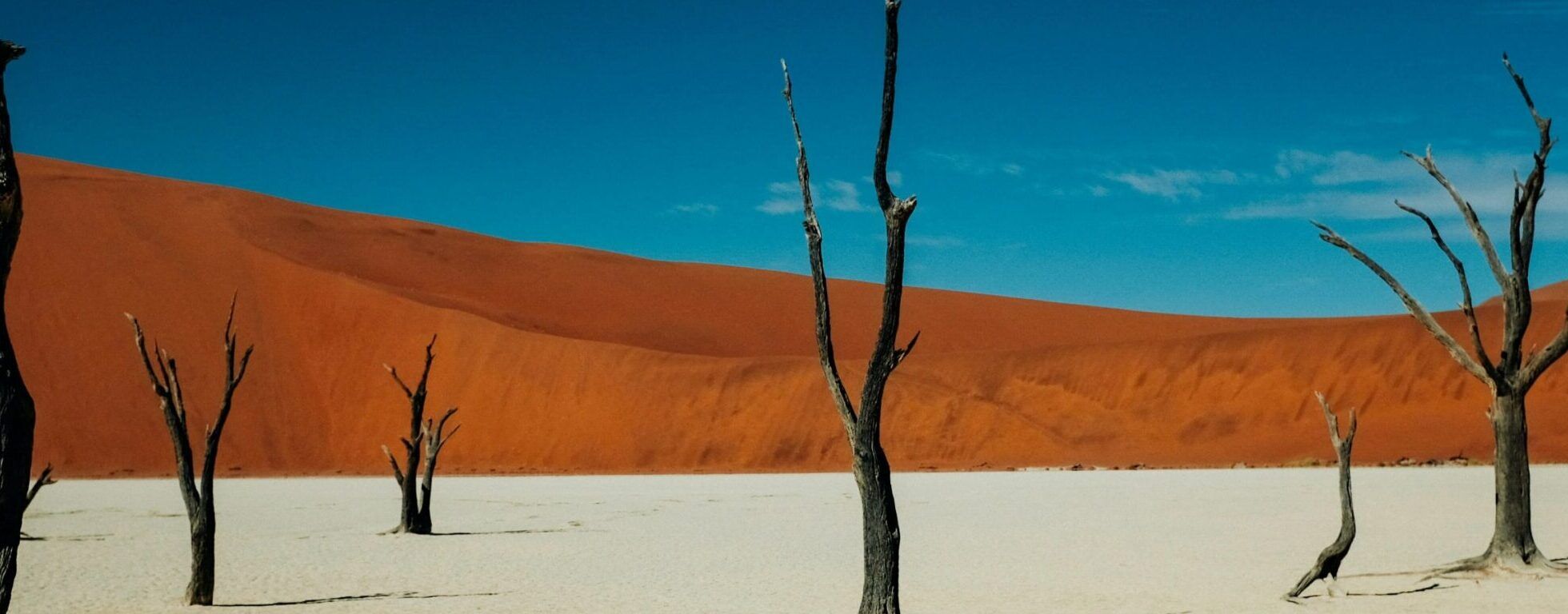
Then, in the middle of it all, there’s Deadvlei – a ‘dead valley’ in between the towering dunes. This stark white clay pan is dotted with 900-year-old camel thorn trees, their blackened skeletons perfectly preserved by the desert’s dry air. This is pure visual theatre and every photographer’s dry dream: inky trees acting as silhouettes on white crusted pans, enveloped by towering rust-red dunes and a deep, deep blue sky.


Life, but not as we know it
Sossusvlei is not without life. Atlantic mist-filled winds bring much-needed moisture to the Namib, allowing life for species that don’t need much. Think striking quiver trees in bright yellow bloom, Nara melons or the ancient Welwitschia plant that can live for over 1,500 years (!). It’s remarkable plants like these that sustain Sossusvlei’s chameleons, beetles and geckos. Endemic species thrive here too, from quirky little creatures with fascinating names (such as the dancing white lady spider or Grant’s golden mole, a mole without physical eyes) to slightly larger desert specialists. Ostrich, springbok, gemsbok and even hyena roam the dunes – all brilliantly adapted to temperatures that soar above 40°C by day and drop below freezing at night.
Information and facts
Sossusvlei is the most iconic corner of the famous Namib Desert. Towering rust-red dunes rise from blinding white salt pans, sculpted by the wind into elegant star shapes over a period of millions of years. Icons like Dune 45 and the towering Big Daddy are the most photographed dunes in the world, while Deadvlei adds a surreal twist, with 900-year-old tree skeletons frozen in time on a stark white pan. And yet, Sossusvlei is teeming with life, thanks to Atlantic mists and ingenious plants. This is desert theatre at its finest!
Most common animals
Animals listed below can be found in the Namib Desert, which means that you could run into them in Sossusvlei (but chances are low!).
- Ostrich
- Springbok
- Gemsbok
- Spotted hyena
- Brown hyena
- Bat-eared fox
- Black-backed jackal
- Porcupine
- Cape fox
- Aardwolf
- Birds, rodents, reptiles and spiders
Facts about Sossusvlei
- Sossusvlei lies in the centre of Namibia in the Namib Desert, where it is part of the Namib-Naukluft National Park.
- It is famous for its massive red-coloured dunes that contrast with white salt pan valleys and amazing blue skies.
- The area is relatively small, but it’s the most famous part of the Namib Desert and, as such, a top tourist destination, drawing over 600,000 visitors annually.
- Big Daddy is the tallest dune in Sossusvlei with a height of 325 metres.
- Dune 45 is the tallest dune to climb on foot, best done at sunrise when temperatures are still bearable.