Travel advice for Uganda
To many the African continent is still a little bit of a mystery, as they don’t exactly know what to expect when travelling there. If you’re one of them, we can already tell you: no worries! Many African countries are safe to explore and so beautiful that they should be explored! To put your mind at ease, we’ve put together some tips for first-timers as well as experienced travellers. This way we can make sure you step into the plane with a good feeling only looking forward to the beautiful wildlife and views you’re about to see!
Your safety is everything
The essentials
To enter Uganda you need a passport which will still be valid for at least six months after your return. You also need a valid visa, for which you can apply on the official Uganda immigration website. The visa for Uganda is single entry, valid for three months and costs 51.50 USD.
Take your shots
Uganda is a tropical country, and some vaccinations are recommended when visiting. Beyond standard vaccinations like MMR and Tdap, the Centres for Disease Control and Prevention (CDC) and the World Health Organisation (WHO) recommend Hepatitis A, Hepatitis B, and typhoid vaccinations for Uganda. Rabies and meningitis vaccinations are also recommended depending on your activities and the season.
Yellow fever
Yellow fever is prevalent in Uganda, and the CDC recommends the vaccine for all travellers aged nine months and older. Also, if you travel to Kenya or Tanzania before or after visiting Uganda, these countries will ask for the certificate. However, the certificate is no longer mandatory to enter Uganda itself.
Please note that if your doctor advises against the vaccine because you are over 60 and/or have a medical condition, a signed exemption letter is accepted instead.
Malaria
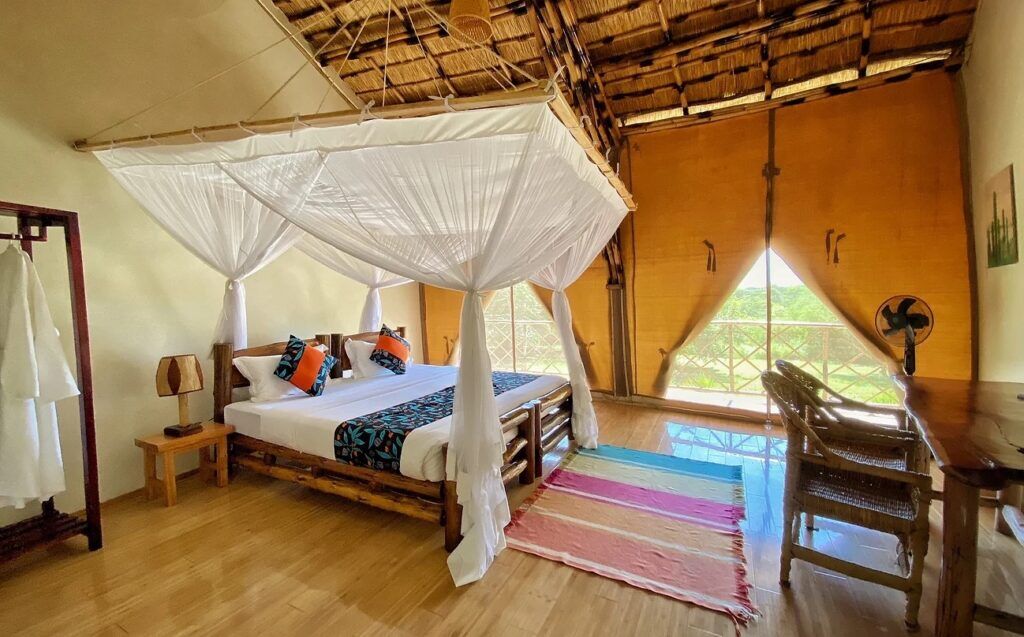
Malaria is present in the whole country. Thankfully, there is preventive treatment, which most visitors make use of. At night, protect yourself with mosquito repellent and long-sleeved tops and trousers. Lodges usually provide mosquito nets in the rooms to keep these little buggers away.
And last but not least, the most valuable tip: talk to your doctor at least eight weeks before travelling to Uganda about any specific precautions you should take.
Excuse me, what time is it?
Uganda is GMT + 3. To put that into terms we all understand without having to calculate too much, simply check the time difference from Uganda to L.A., New York, London and more below.
Los Angeles: -11 hours
New York: -8 hours
London: -3 hours
Berlin: -2 hours
Hong Kong: +5 hours
Tokyo: +6 hours
Sydney: +8 hours
Auckland: +10 hours
Money matters
The local currency is the Ugandan shilling, although dollars and euros are also accepted in most places. One euro is approximately 4,000 Ugandan shillings, whereas one dollar is approximately 3,800 Ugandan shillings.
Words can speak volumes
The official national languages of Uganda are English and Swahili, with English being most popular and most used – mainly because the country was a British protectorate until 1962. This means almost everyone in Uganda speaks English, at least in the capital. In rural areas, English is less spoken though.
Safety First: Don’t Leave Without Travel Insurance
Your Uganda adventure awaits, but before you hit the road, ensure you’re covered with comprehensive travel insurance. At Africa Safari Trips, we prioritize your safety above all else, which is why we strongly advise insuring yourself and your trip with Chapka Travel Insurance.
With Chapka’s tailored coverage and 24/7 medical teleconsultation, you can explore Africa with confidence, knowing you’re protected against any unexpected twists and turns. So, as you prepare for your Uganda trip, remember: Safety First. Don’t Leave Without Travel Insurance, and trust Chapka to have your back every step of the way.
Simply take out your policy directly on the Chapka website.
Let us create your tailor-made trip
Receive a free, no obligation quote
Start planning your dream trip