Travel Advice

Great that you’re planning a trip to South Africa, or thinking about it. This destination offers an incredible variety of breathtaking experiences, combined with a modern, well-developed infrastructure. As one of the more ‘western’ countries on the African continent, the culture shock is often limited.

To help you prepare, we’ve put together some practical tips and advice, so you can board your flight with peace of mind and focus on the incredible experiences that await you.

Visa

Travelers with a passport from the European Union, United States, United Kingdom, Canada, or Australia generally do not need a visa for short stays in South Africa (up to 90 days).
Travelers from some countries are required to apply for a visa in advance. Requirements vary by nationality, so it’s important to check the latest regulations before traveling.
For the most up-to-date information, please consult the official website of the South African Department of Home Affairs.

As long as your trip is for tourism or business and doesn’t last more than 90 days you don’t need a visa. Make sure not to overstay, or you will be put on the non-wanted list for the next five years. And that would be a pity because you’ll definitely want to come back 🙂

Travel Insurance

When it comes to embarking on your dream adventure to South Africa, your safety is our top priority! That’s why we urge all travelers to ensure they have comprehensive travel insurance in place before setting off.

A comprehensive travel insurance policy provides peace of mind by covering medical emergencies, trip disruptions, and other unforeseen events. This is especially important in remote areas, where access to medical care may be limited. With the right insurance, you can fully enjoy your safari knowing you’re well-prepared.

While Africa Safari Trips doesn’t provide travel insurance directly, we happily recommend Chapka Travel Insurance as your go-to provider for your upcoming trip.

With Chapka, you’re covered for key aspects of your journey, from medical expenses to trip cancellations. Thanks to their personalized approach, you only pay for what you need. So you can travel with peace of mind and fully enjoy your safari.

Vaccinations

There are no compulsory vaccinations required when entering South Africa. All travelers should obviously be up-to-date on their normal routine vaccinations, but to make it easy, no documentation is needed when crossing the South African border.

Read more in the Health & Safety section below.

Tip: always check the site of the World Health Organization (WHO) for the latest updates.

Tipping

Tipping in South Africa is common, but the rules can vary slightly depending on the situation.

Yes, tipping is common in South Africa and often expected, especially in restaurants. A tip of around 10 to 12% is standard.

In most cases, tips are not included in the bill. Some higher-end restaurants may include a service charge, but this will always be clearly stated on your bill. If not, you can simply add the tip (or ‘gratuity’) yourself.

In cases where you’ve agreed on a price in advance, such as with a taxi, the tip may already be included.

Currency & Money

In South Africa, payments are mostly digital, which makes it easy and convenient. But it’s good to know how currency and payments work before you go.

The South African rand (ZAR) is the official currency. US dollars are generally not accepted. As a rough guideline, you can divide prices by 18 to 20 to estimate the value in dollars, but always check the current exchange rate as it can fluctuate.

Yes, card payments are widely accepted and often preferred. You can usually use your regular debit or credit card, just make sure to inform your bank before traveling. ATMs are widely available if you need to withdraw cash.

The amount of spending money you’ll need depends on your travel style and what is included in your itinerary. In South Africa, most travel packages are based on bed and breakfast (unless indicated differently in the itinerary), so you should also budget for lunches and dinners, in addition to drinks, tips, souvenirs, and optional activities.
As a general guideline, bringing around 3,000 to 6,000 ZAR per person per week (or the equivalent in a mix of cash and card payments) is usually sufficient for personal expenses during your trip.
Credit and debit cards are widely accepted in hotels, restaurants, and shops, especially in cities and tourist areas. Cash is mainly useful for tipping, small purchases, or visits to local markets. ATMs are readily available, so there’s no need to carry large amounts of cash at once.

Language & Culture

South Africa is called ‘the rainbow nation’ for all the right reasons, and with no less than eleven official languages, it’s a melting pot of different cultures and ethnic traditions.

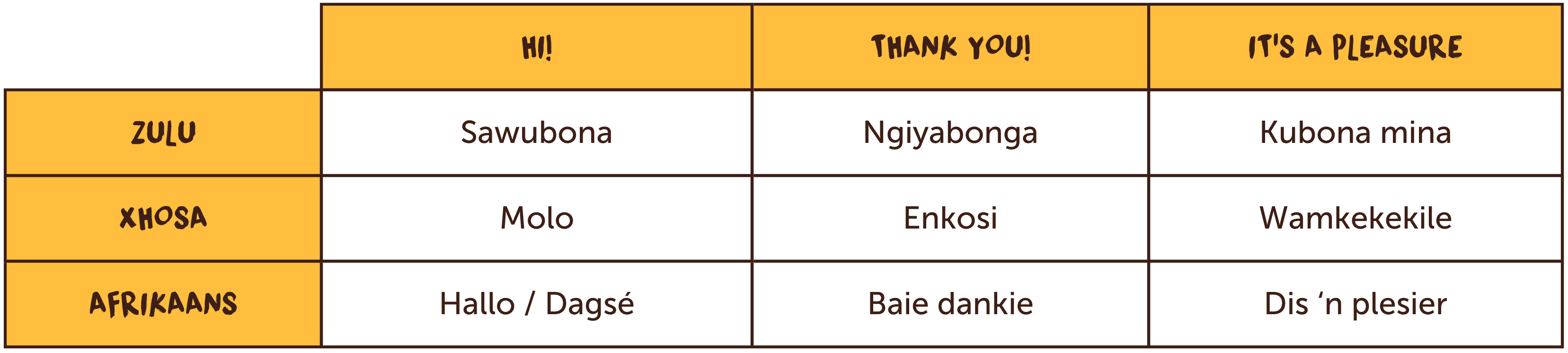
Zulu and Xhosa are among the most widely spoken languages in South Africa, while Afrikaans is the first language of around seven million South Africans and is spoken across various communities throughout the country. While most South Africans can communicate in more than one language, English is the most commonly spoken and the language of official business and commerce.

If you’re keen on communicating with the locals, you can start with these words:

South Africa is a culturally diverse country, with traditions and social norms that vary between communities, languages, and religions. In general, familiar etiquette applies: be polite, avoid staring or pointing, and show appreciation to your hosts. Dining customs differ: some people use cutlery, while others eat with a spoon or their hands, all perfectly acceptable.

Respect for elders is an important value. Older people are addressed with extra courtesy, sometimes using terms like oom (uncle) or tannie (auntie). Visitors aren’t expected to use these, but it’s appreciated when done thoughtfully.

Time Difference

Wondering about the time difference? Here’s what to expect when traveling to South Africa.

South Africa is in the South Africa Standard Time (SAST) zone and does not observe daylight saving time.

For European travelers, there is little to no time difference: South Africa is 1 hour ahead of Central European Time (CET) in winter and the same time during the rest of the year.

For travelers from the United States, South Africa is 6 to 9 hours ahead, depending on your location.

What to Bring

Packing for a safari in South Africa is all about balancing comfort, practicality, and preparedness for changing conditions. You’ll spend time in open landscapes and safari vehicles, so bringing the right items will help you make the most of every game drive. Below, you’ll find answers to common questions about what to pack, so you can head into your South Africa safari well-prepared and relaxed.

For a safari in South Africa, pack lightweight, comfortable clothing in neutral tones such as khaki, sand, or olive to stay cool and blend into the natural surroundings during game drives. Key items include a sun hat, sunglasses, sunscreen, comfortable closed shoes, and a light jacket or fleece for early mornings and evenings. A camera with spare batteries or chargers is also essential to capture unforgettable wildlife encounters.

Yes, wearing comfortable and practical clothing will enhance your game drive experience in South Africa. Temperatures can change throughout the day, so layered clothing is ideal; early mornings may be cool, while afternoons are often warm. Neutral colors help you blend into the natural surroundings and are less distracting to wildlife. Closed, comfortable shoes are recommended for walking and for getting in and out of safari vehicles.

Alongside your clothing, bring personal essentials such as prescription medication, insect repellent, sunscreen, lip balm, and a reusable water bottle. Binoculars are useful for spotting wildlife at a distance, and a small daypack comes in handy for carrying valuables and daily essentials during game drives or short walks.

It’s advisable to leave bright or eye-catching clothing and strong fragrances at home, as these can attract insects and take away from the wildlife experience. High heels and heavy boots aren’t practical on safari; comfortable walking shoes are a much better choice. Soft-sided, compact luggage is also recommended, as space in safari vehicles and small aircraft can be limited.

Yes. Be sure to carry essential travel documents such as your passport, visa (if required), travel insurance details, and copies of your flight information. For day-to-day expenses, it’s useful to have a combination of South African rand (ZAR), a credit or debit card for payments, and a small amount of cash for tips or minor purchases. Keep important documents and valuables safely stored at all times.

Safari Costs

For many travelers, a safari in South Africa is a true bucket-list experience. But what does it actually cost, and what can you expect for your budget? The good news is that safaris come in a wide range of options, from accessible self-drive adventures to more exclusive lodge stays. We’ll provide you a clear overview.

The cost of a trip to South Africa varies depending on your travel style, but it is generally more flexible than in many other safari destinations.

Most itineraries are based on a self-drive setup with accommodation on a bed & breakfast basis. As a guideline, you can expect prices to start from around 150 to 250 USD per person per day, excluding lunches, dinners, park fees, and activities such as game drives.

Costs can increase depending on your choice of accommodation, the type of parks or private reserves you visit, and whether you add guided activities or upgrade to more exclusive lodges.

Several factors determine the final cost of your safari. Key elements include the travel season, the type of accommodation (mid-range vs. luxury), the length of your trip, and whether you visit national parks or private game reserves. Private reserves often offer more exclusive experiences at a higher price point. Additional activities, level of comfort, and whether the safari is private or shared also play an important role in the total cost.

Safari prices in South Africa vary depending on the season and region. The peak safari months are generally during the dry winter period from May to September, when wildlife is easier to spot and demand is higher. This results in higher prices, especially in popular private reserves. The summer months (November to March) often offer better rates, greener landscapes, and fewer visitors, while still providing excellent game viewing, making this period attractive for travelers seeking good value.

In South Africa, most travel packages are based on a self-drive itinerary with accommodation on a bed & breakfast basis. This means your stay and daily breakfast are included, while lunches, dinners, park fees, and activities such as game drives are usually paid separately.

Guided game drives, entrance fees, and additional experiences can often be added per location or booked in advance, depending on your preferences.

International flights, visas (if applicable), travel insurance, tips, drinks, and personal expenses are not included and should be budgeted separately.

Yes. One of the great advantages of a tailor-made safari in South Africa is its flexibility. You can adjust the overall cost by choosing different accommodation levels, traveling outside peak seasons, modifying the length of your itinerary, or selecting reserves and parks with varying entrance fees. By balancing comfort, travel pace, and timing, it’s possible to create a South Africa safari that fits your budget, while still delivering an outstanding wildlife experience.

In South Africa, we currently focus on private self-drive safaris, giving you the freedom to explore national parks and scenic routes at your own pace. This travel style is very popular thanks to South Africa’s excellent road infrastructure and well-organized parks.

If you prefer more guidance, a private guide can be arranged on request, either for specific activities or parts of your itinerary. Looking ahead, we are also planning to introduce group trips and guided safari options in national parks, offering even more ways to experience South Africa’s wildlife.

Food

Good food plays an important role in any safari experience, and South Africa offers a wide variety of flavors and dining options. You have the freedom to choose where and how you enjoy lunch and dinner. Whether at your lodge, in a nearby restaurant, or during your self-drive adventure.

No. In South Africa, safari accommodations are usually booked on a bed & breakfast basis. This means breakfast is included, while lunch and dinner are typically enjoyed at local restaurants, lodges, or camps along your route and are paid separately. This setup offers more flexibility and the opportunity to explore South Africa’s diverse food scene at your own pace.

South Africa offers a diverse and high-quality food scene. You can expect a mix of international dishes and local specialties, often prepared with fresh, seasonal ingredients. From relaxed lodge breakfasts to à la carte dinners and traditional South African cuisine, there is plenty of variety to suit different tastes and dietary preferences.

Yes. Most lodges, guesthouses, and restaurants in South Africa are well-equipped to cater to dietary requirements such as vegetarian, vegan, gluten-free, or allergies. Simply let us know your preferences in advance so we can take them into account when planning your trip.

In South Africa, game drives are often done at your own pace as part of a self-drive itinerary. This means you can plan your meals flexibly, for example by returning to your accommodation, stopping at rest camps inside the park, or bringing your own snacks or picnic.

No. Drinks are generally not included during your safari in South Africa unless explicitly stated by the accommodation. Soft drinks, alcoholic beverages, and specialty coffees are usually charged separately and settled directly at the lodge or restaurant.

Guides

In South Africa, safaris are typically self-drive, giving you maximum flexibility and independence. Prefer to travel with a guide? That can easily be arranged, so you can tailor your trip to your own preferences.

Our guides speak English as standard, which is widely used throughout South Africa. Depending on availability, it may also be possible to request guides who speak other languages. Please note that language-specific guides are always on request and may involve an additional cost.

Yes. All guides we work with in South Africa are professionally trained and certified. Their training covers wildlife knowledge, conservation ethics, guest safety, and responsible guiding practices. Many also have extensive field experience in national parks and private reserves, ensuring a high standard of professionalism and an engaging, safe safari experience.

No. In South Africa, safaris are generally offered as private self-drive trips, so a private guide is not included by default. However, if you prefer to travel with a guide, this can certainly be arranged on request. Guided safaris or specialist guides are available at an additional cost, depending on availability and your itinerary.

Yes. Our guides in South Africa are happy to tailor the experience to suit families or specific interests. Whether you’re traveling with children, enjoy wildlife photography, have a strong interest in birds, or want to focus more on nature, culture, or conservation, the itinerary and daily activities can be adjusted accordingly. Simply share your preferences in advance so we can plan a safari that matches your travel style.

Extensions & Activities

South Africa is an incredibly diverse destination, perfect for extending your safari with additional experiences. From vibrant cities and scenic coastlines to unique landscapes, there are plenty of ways to enrich your journey at your own pace and according to your interests.

South Africa is one of the most versatile safari destinations, offering nature, culture, and city life in one trip. Popular extensions in South Africa include:

These extensions are perfect for travelers who want to combine safari with scenic drives, gastronomy, and coastal experiences. Here you’ll find an overview of all activities.

Best time to visit South Africa

South Africa is a year-round stunner and offers a diverse range of experiences. From the thrill of encountering the Big Five in Kruger National Park to the diverse wildlife of the Garden Route, there’s something for every adventurer. Whether you’re seeking sun-drenched beaches, lush landscapes, cultural immersion, or indulging in world-class wines in the Cape Winelands, South Africa delivers.

The best time to visit South Africa depends on what you want to experience: from safaris to coastal scenery and vibrant cities.

May to September (dry season in the north)

These months are generally considered the best time for wildlife viewing in areas like Kruger National Park. The dry season brings clear skies, cooler temperatures, and better visibility as animals gather around water sources.

However, this period is winter in the Cape region (including Cape Town), where you can expect cooler temperatures and a higher chance of rain.

December to February (summer)

Summer brings warmer temperatures and lush landscapes across much of the country. This is a great time to visit the Cape, with long sunny days and ideal conditions along the coast.

In safari areas, vegetation is denser, which can make wildlife slightly harder to spot, but it’s also the season when many animals give birth, offering a unique and rewarding experience.

You’ll find more information in our article: “When to visit South Africa?

May to September offers the best conditions for wildlife spotting in areas like Kruger National Park, with dry weather, clear skies, and better visibility as animals gather around water sources.

If you’re interested in whale watching, the best time is from June to November, when southern right whales can be seen along the coast, especially around Hermanus.

Yes. South Africa can be a very enjoyable destination during the rainy season, which generally falls between November and March in the northeastern parts of the country, including Kruger National Park.

Rain usually comes in short, refreshing showers rather than continuous downpours, and the landscapes become lush and green. Wildlife viewing remains good, and this period is especially rewarding for birdwatching. Fewer visitors and more attractive rates can also make this a great time to travel.

In contrast, the Cape region (including Cape Town) experiences its rainy season from May to September, with cooler temperatures and a higher chance of rain during these months.

There is no bad time to visit South Africa, only different travel experiences. Each season has its own highlights, whether you’re interested in wildlife viewing, pleasant weather, fewer crowds, or better value. We’re happy to help you choose the best time to visit based on your interests, travel period, and expectations.

Weather South Africa

What kind of climate does South Africa have?

The weather can vary greatly between regions; from hot, sunny days to cooler mornings and occasional rain. Whether you’re heading to Kruger or exploring Cape Town, understanding the climate will help you make the most of your trip.

Below we answer some frequently asked questions, and you could also take a look at our weather guide where we show you the climate per region.

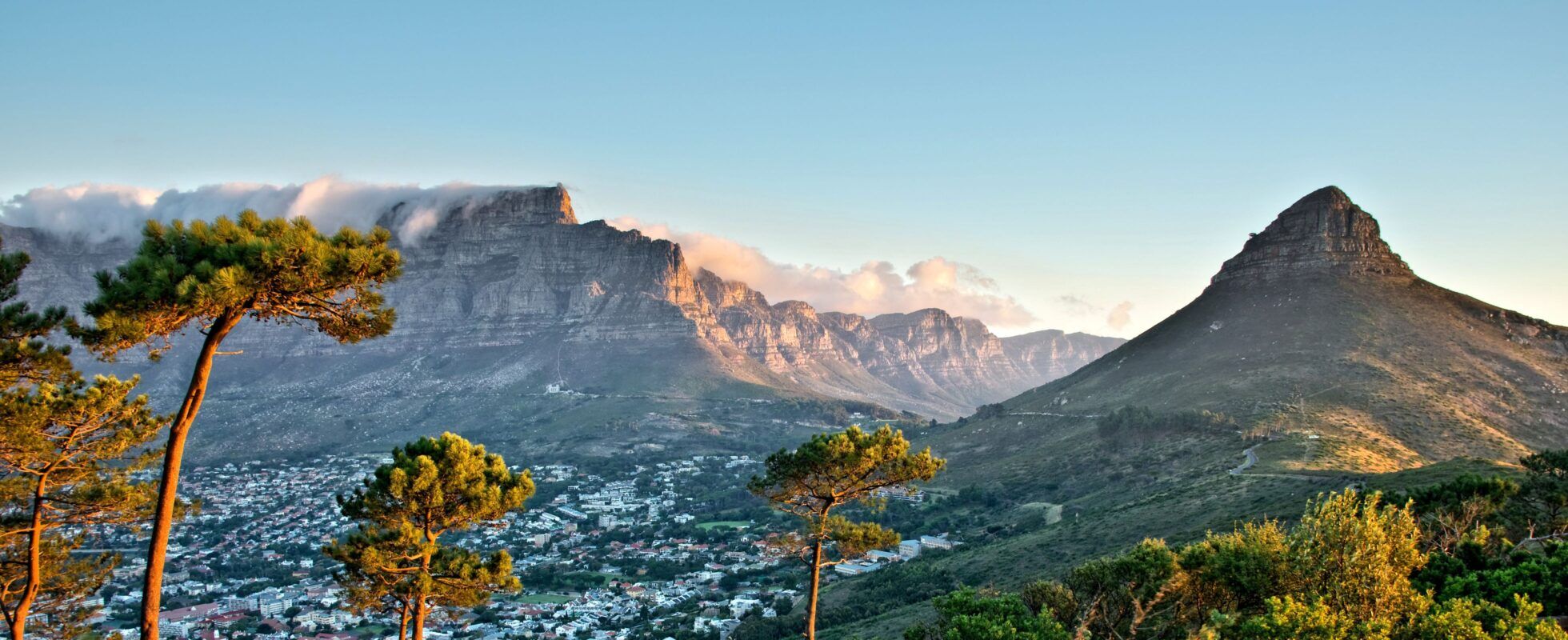
Cape Town (Western Cape Province) has a maritime climate with warm, dry summers (around 25 °C/77 °F) and cooler, wetter winters (down to 7 °C/44 °F). The southeastern wind brings relief during hot days, while winter can even bring snow to higher mountain areas. On Table Mountain, the famous “Table Cloth” cloud often adds moisture to the otherwise dry landscape.

This region (in the Mpumalanga and Limpopo Provinces) experiences tropical weather in the lower regions (called the Lowveld), with warm temperatures and high summer rainfall (remember to pack insect repellent and malaria medication!). In these lower regions, June and July are coolest and most dry, with a pleasant 20 °C (68 °F). The higher regions (or Highveld), on the other hand, see more temperature extremes, swinging between 8 °C and 26 °C (46 °F and 79 °F).

Johannesburg is located in Gauteng Province, where summers are warm and often bring afternoon thunderstorms, sometimes with lightning and occasional hail. Temperatures typically range from 17 °C to 28 °C (63 °F to 82 °F).

Winters are mild and dry, with temperatures between 5 °C (41 °F) and 19 °C (66 °F). Mornings and evenings can feel chilly, so it’s best to pack layers if you’re visiting during June to August.

Durban (KwaZulu-Natal Province) offer warm vibes almost year-round. Summers are humid and hot, while winters stay mild. Average water temperatures of 23 °C (73 °F) mean you can hit the surf most of the time. The wettest months are October to January… you might want to pack an umbrella for those.

Vaccinations

There are no compulsory vaccinations required when entering South Africa. All travelers should obviously be up-to-date on their normal routine vaccinations, but to make it easy, no documentation is needed when crossing the South African border.

Tip: always check the site of the World Health Organization (WHO) for the latest updates.

No, there is no yellow fever disease in South Africa, and you can’t contract it there.

Malaria risk in South Africa is limited to certain areas in the northeast of the country, including parts of Kruger National Park and Mapungubwe National Park, mainly between October and May.

If your itinerary includes these regions, it’s important to take precautions such as wearing long sleeves and trousers after sunset and using insect repellent. Our lodges in malaria-prone areas are usually equipped with mosquito nets.

For advice on malaria prevention and whether medication is recommended for your trip, we strongly advise consulting a qualified healthcare professional or travel clinic before departure.

Safety in South Africa

South Africa is a popular and rewarding destination, where many travelers combine a safari with a stay in cities like Cape Town or Johannesburg. As in any large city, it’s important to stay aware and follow basic safety advice. With the right preparation and local guidance, you can travel comfortably and with confidence.

South Africa is a popular travel destination, but it’s important to be aware that some areas require a bit more caution than others.

That said, most travelers visit South Africa without any issues, especially when staying in well-known areas such as Cape Town, the Cape Winelands, the Garden Route, and national parks like Kruger.

By staying aware of your surroundings, avoiding risky situations, and following local advice, you can travel safely and enjoy everything this diverse country has to offer.

Simple precautions go a long way. Stay aware of your surroundings, especially at night, and avoid leaving valuables in your car or in plain sight. Use hotel safes where available and rely on registered taxis or arranged transfers.

It’s generally recommended to avoid driving after dark, especially in more remote areas. Also, keep your car windows closed. In some areas, baboons may see an open window as an invitation to climb in and grab anything they can find.

By staying alert and taking basic precautions, most travelers enjoy South Africa safely and with peace of mind.

Read more in our article about essential travel tips for a safe adventure.